
Guide · Immersive Dolby Atmos mixing
A Dolby Atmos mix for headphones and for speakers: behind the scenes of Hearing the Call
How we worked on the Dolby Atmos mix of Loh's album so that it holds up on headphones, in binaural, as well as on speakers, in two rooms with different configurations and calibrations. HRTF, vocals in height, bed and objects, LFE, wide speakers: the mixing choices and the checks made with ADM Scope.
Loh's album Hearing the Call moves between contemporary folk, alternative pop and melodic rock, with fairly cinematic arrangements. In Atmos, the point was not to pile up spatial effects: we wanted to preserve the presence of the voice and let the arrangements grow around it.
The mix was made by White Mastering Studios. The online magazine Magic Vinyl Digital published an independent review of it. We had the opportunity to answer a few questions from Magic Vinyl Digital, and we thank them for giving us the chance to explain how we work and our philosophy.
This article does not repeat the review. It tells what happened in the session: the placement choices, the reasons behind them and the checks made before delivery.

1. One mix, several ways of listening
A Dolby Atmos master does not correspond to a single playback. It contains channels, objects and metadata, and the rendering depends on the playback system: a 9.1.4 room, a 7.1.4 room or headphones in binaural do not produce the same scene. The job is to make choices that hold up in all these conditions.
We treated headphones as a real mixing constraint, not as an end-of-session check. On speakers, we wanted to check that the mix translated to two reference rooms with different layouts and calibrations. In both cases, the artist's request was the same: keep a vocal presence comparable to that of the stereo mix.
Two binaural renders, two listening experiences.
Headphone rendering varies with the platform, the device and the settings. In our comparative listening, Apple Music's render seemed wider to us than that of the Dolby engine used for monitoring, and the voice lost some presence and precision in the centre. That is one of the reasons we kept it away from the sides. This observation applies to our monitoring chain, not to every device.
2. HRTF, simply explained
HRTF stands for Head-Related Transfer Function. It describes how a sound coming from a given direction is filtered before it reaches each ear. The head, the torso and above all the outer ear (the pinna) alter the signal, and these differences give the brain cues to locate a source in space.
For left-right position, the brain relies mainly on the differences in arrival time and level between the two ears. For height and front-back distinction, the spectral cues linked to the shape of the pinna matter a great deal. A binaural engine uses filters derived from HRTFs to recreate these cues on headphones and give the impression that a sound comes from a precise position around the listener.
For the mixer, this has two consequences. First, unless a personalised profile is used, the HRTF applied does not exactly match the listener's anatomy: the perception of height, front-back and depth varies from one person to another. Second, frontality on headphones depends heavily on the profile and the engine. On our monitoring system, some frontal placements lost a little presence compared with listening on speakers, and that is what guided the placement of the voice.
3. The voice in the vertical dimension
On tracks 01, 02, 03, 06 and 07, we worked on the height of the secondary vocals rather than their width. The lead vocal stays anchored at the front, with the centre channel as a reference. Doubles and some harmonies are placed higher, at an elevation of about +15° to +30°, a choice we also discussed with Nicolas Martin of NM Audio, who mastered the stereo version of the album. The aim: clear the horizontal plane without pushing the lead vocal away.
Decluttering the horizontal plane
At ear level, the front and side scene fills up quickly: guitars, synths, brass, delays, reverbs and drum elements share the same space. Placing some vocal elements higher makes it possible to separate them without asking everything of EQ. It does not work for every sound, but it is one more tool when the playback system allows it.
A behaviour to check in binaural
On headphones, the perception of height relies largely on the spectral cues of the pinna. A voice placed slightly above the horizon can give an impression of elevation and bring the sound out of the head, without having to push it far to the sides. Conversely, a very wide pan can make the centre image less stable and make the voice feel distant. Working vertically let us create space while keeping a frontal anchor.
A creative intention too
The secondary vocals placed in height are not only there to free up space. They bring another colour: depending on the passage, they give a chorus more breadth or reinforce the intimacy of a line. The perceived height comes mainly from the spatial cues recreated by the binaural render, not from the high frequencies of the voice alone.
4. Bed and objects: the architecture of the mix
In Dolby Atmos, a mix combines a bed, that is a set of channels, and objects whose position is described by metadata. The renderer then adapts their playback to the available system. On Hearing the Call, we built the bed around what had to stay stable: lead vocal, drums and bass. The rest is handled as objects when that serves the mix.
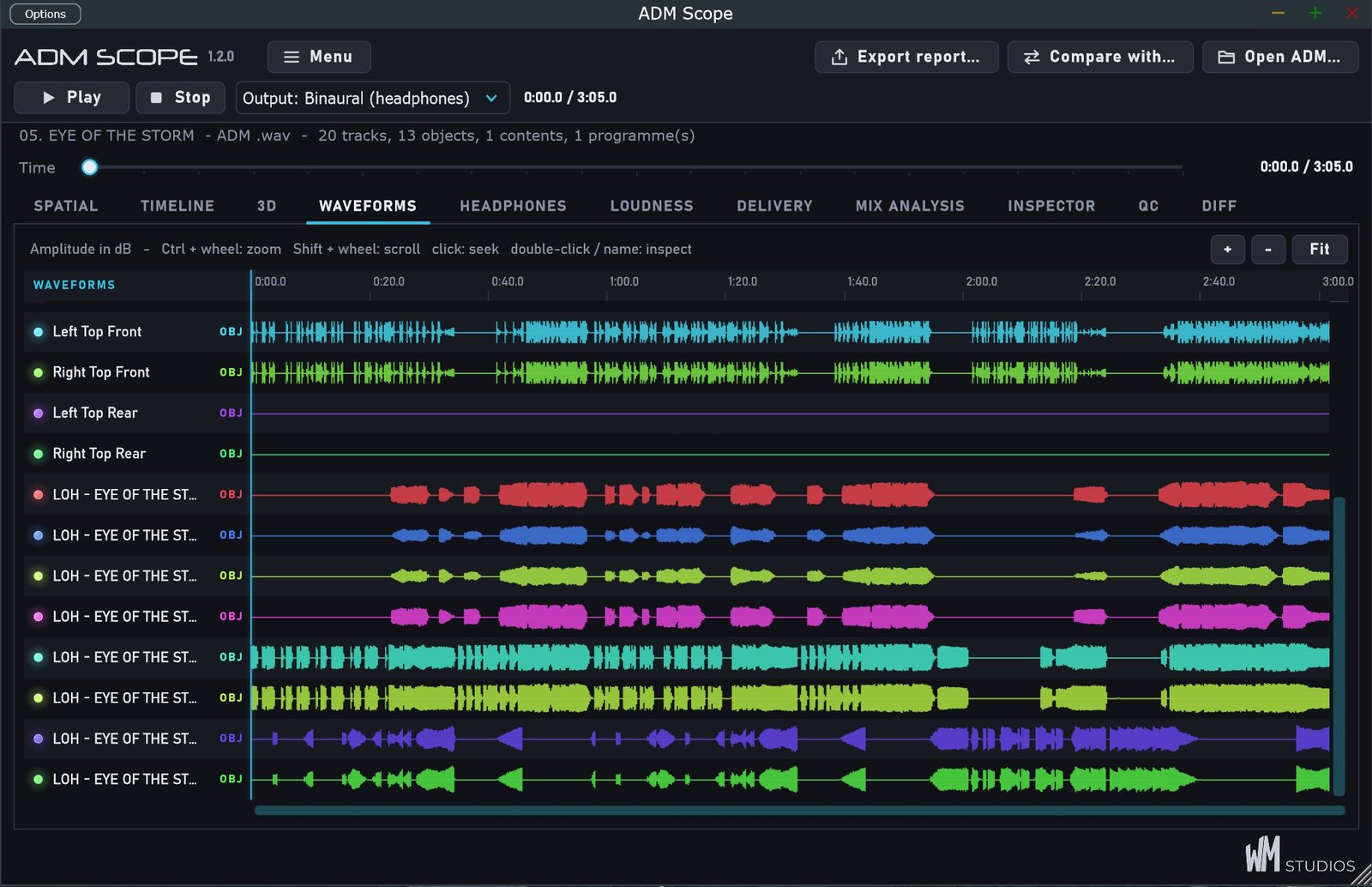
This gives us a clear foundation, and the objects are used to work more freely on width, depth and height. The idea is not to take as many elements as possible out of the bed, but to keep objects for the sounds whose position or movement adds something. On Eye of the Storm, for example, the drums and percussion of the chorus are separate objects, to better control their localisation and their entry in that section.
5. Low end and LFE
The LFE channel is not a copy of the bass instruments. We use it as reinforcement, depending on the arrangement: some components of the bass, the kick and the drums are sent to it in addition to their presence in the main channels. The signal is filtered, so the instruments do not go through this channel in full.
In its analysis of the 9.1.6 render, Magic Vinyl Digital notes a 120 Hz low-pass on the LFE. This is consistent with the starting point recommended by Dolby for LFE routing in Atmos Music: a high-pass around 20 Hz and a low-pass at 120 Hz.
6. Heights, wides, trajectories and depth
The height speakers carry the high vocals, the harmonies and some instrumental elements. The wides are used to widen the scene, for example for the staccato synth lines or the lead guitar depending on the section. Object trajectories connect the front, the sides and the rear, and depth is also built with the surround elements and the reverbs sent to the rear.
Wides do not exist in every layout. In a room that has none, the renderer adapts the playback to the available speakers, so an object placed in a wide zone will not be reproduced the same way in 7.1.4 as in 9.1.4. That is worth keeping in mind when comparing our two installations.
We also tried to make the spatialisation evolve from one track to the next, and sometimes within a single track. If the same positions and the same movements come back everywhere, the effect quickly becomes predictable. The scene has to follow the music: open up, tighten, move, gain height or depth when the arrangement calls for it.
7. Two rooms, two layouts, two calibrations
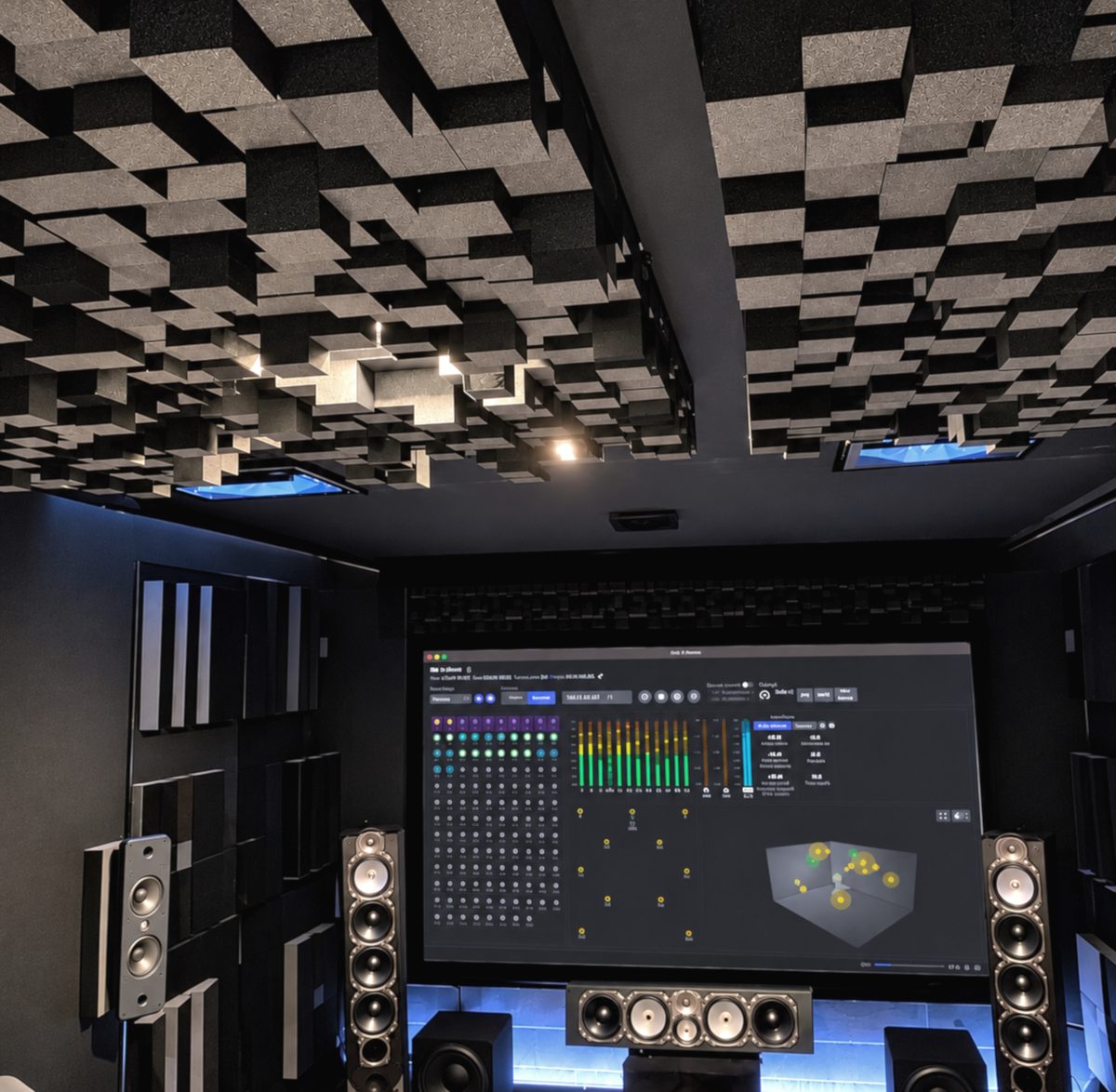
We checked the mix in two Dolby Atmos rooms that differ in layout, speakers and calibration. It is a good way to spot choices that would only work in one room. It does not guarantee an identical result for every listener, but it gives a second, concrete checkpoint.
Dolby Atmos · 7.1.4 · four subwoofers
Alcons
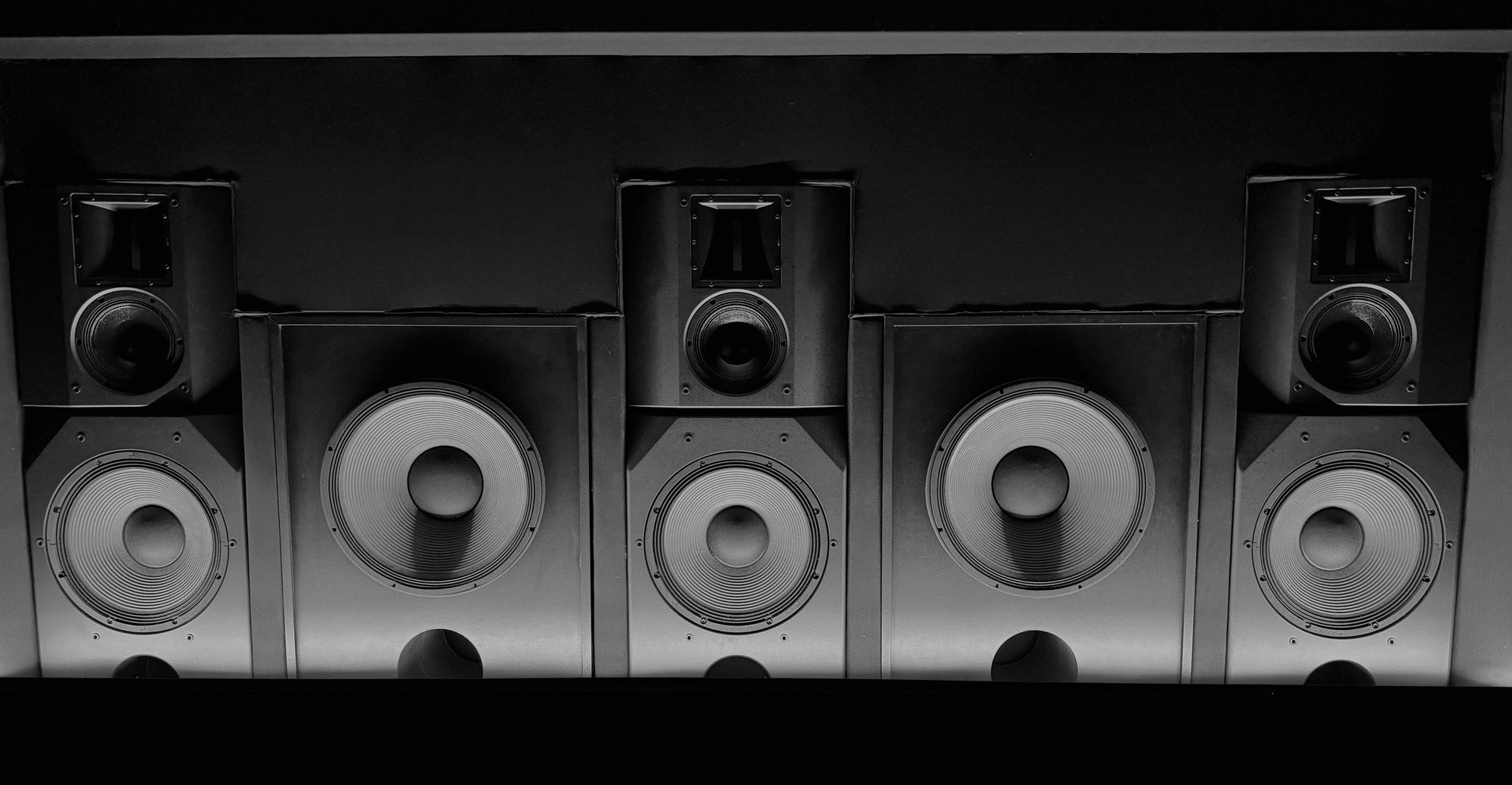
Alcons monitoring, calibrated with Trinnov Optimizer, with WaveForming to optimise the low end. Listed as a Dolby Atmos Music room.
DiscoverA word on notation: in the Dolby designation, the middle number is the LFE channel, not the number of subwoofers. Our two rooms each have four subwoofers, over which the LFE channel can be distributed in addition to any bass management. They are therefore written 9.1.4 and 7.1.4.
The two layouts do not have the same number of speakers at ear level, and Dirac ART and Trinnov Optimizer with WaveForming do not act on the room in the same way. After checking in both rooms, the mix translates well: the voice keeps its frontal presence, the scene stays readable, and the height and width placements keep their intention. This is our listening observation, not a comparative measurement.
This double check protects against a mix that would only work on headphones, or only in one room.
8. ADM Scope: checking what the file contains
Before judging by ear, we check the file itself with ADM Scope, analysis software for ADM / BW64 immersive masters that we developed at WM Studios. It is our own tool, independent of Dolby Laboratories and Apple. Its speaker and headphone renders are used for checking and do not replace the renderer of the mixing tool.
On this project, it mainly helped us examine the positions of the objects and check the delivered file.
Objects coming close together
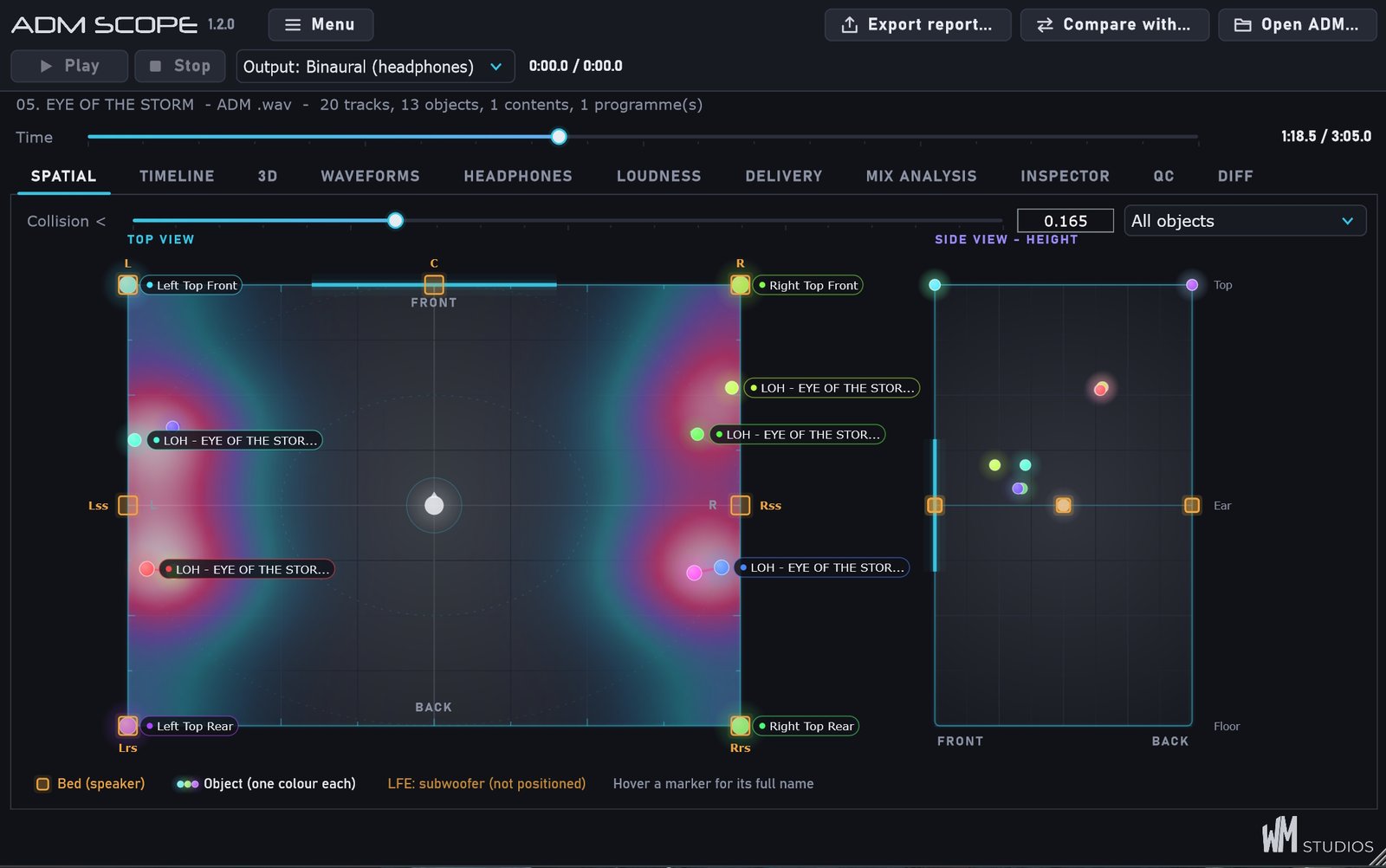
When several elements leave the bed to become objects, like the synth on Notebook, the guitars on Already Gone or some raised vocals, their positions can come close at the same moment. They do not necessarily mask each other, that depends on the frequency content, the level and the movement, but their localisation can become less distinct. ADM Scope flags these approaches and shows density in several spatial views (top, side, orbitable 3D), with a timeline of the objects. This makes it easy to spot the passages worth listening to again, whatever the room.
Mix analysis
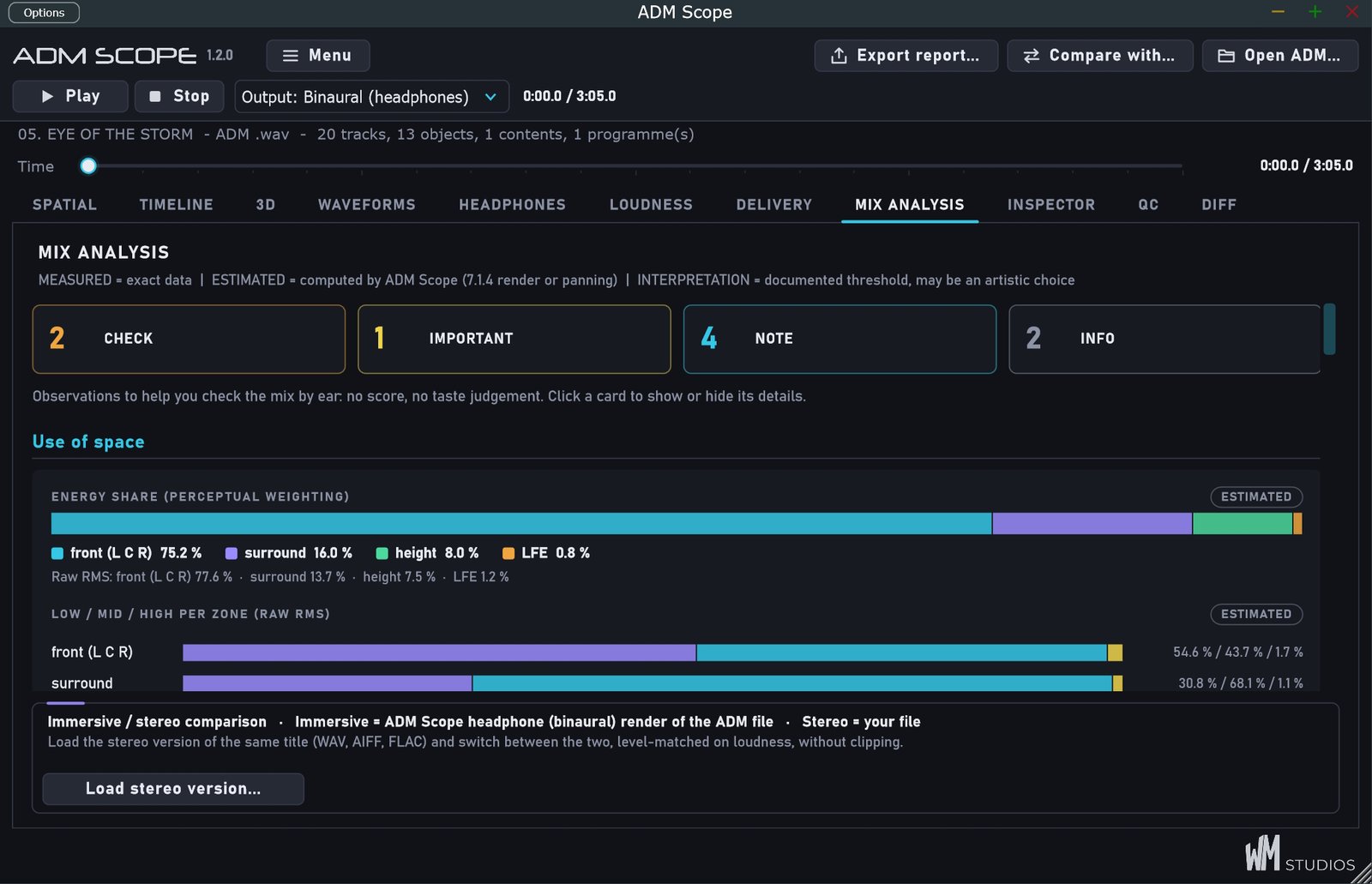
The tool shows the distribution of energy by zone (front, surround, heights, LFE) with perceptual weighting, the low, mid and high balance, and dynamics indicators. Each value is labelled as measured, estimated or interpreted. These are reference points, not a quality score. For a project that relies on vertical vocals and a complementary LFE, they make it possible to check where the energy is concentrated.
File checks and comparative listening
ADM Scope checks the ADM structure and metadata against the ITU-R BS.2076 model. Among other things, it flags silent tracks, position changes worth examining and binaural render settings, that is the Binaural Render Mode metadata (Off, Near, Mid and Far) documented by Dolby for objects and bed channels.
It measures the loudness, true peak and loudness range of the bed. For the full mix, the values are estimated from a 7.1.4 render: they should therefore be read as results tied to that render, since the loudness of an object-based programme can vary with the rendering conditions. Recommendation ITU-R BS.1770-5 covers the measurement of loudness and true peak, including for object-based content.
It also makes it possible to compare binaural and stereo at equal loudness, so as not to confuse a difference in level with a difference in rendering, and it accepts HRTFs in the SOFA format, standardised by the AES as AES69, to compare how the mix behaves with different profiles. To prepare a master for delivery, our resource Delivering in Dolby Atmos details what is expected.
ADM Scope is available as a 14-day free trial, then as a perpetual licence at €99. The licence covers the application and the VST3 plug-ins, plus the AU format on macOS. The software runs on Windows and macOS, and the analyses are done locally.
9. Track by track
The album has seven tracks: 4 Years, Notebook, Already Gone, Love You From Another Place, Eye of the Storm, Intruder and Seasons. Here are the choices that shaped six of them.
01 · 4 Years
The mix builds on the stereo recording of the piano and the guitar. We worked on their spatialisation so that the elements gradually come away from the walls and the scene opens up from the start. The movement of the voice required particular care, and the high vocals are placed in the front left and front right height speakers. The bass is spread between the main channels and the LFE.
02 · Notebook
The timpani roll at the end of the track is a spatial element in its own right, with a trajectory towards the rear of the scene. The portamento synth leaves the bed to be localised more precisely: depending on the passage, it moves to the wides or becomes an object in height, with a left-right trajectory above the listening position. The kick contributes to the low end, with a send to the LFE.
03 · Already Gone
The piano motif has a precise placement. In the last chorus, a guitar movement starts at the rear of the scene and moves towards the listening position. When the chorus arrives, the guitars are spread symmetrically on the sides to open up the scene and create a lateral envelope, while keeping enough dynamics for them to breathe. The verses stay very clear.
05 · Eye of the Storm
A vocal movement in the pre-chorus serves as a transition into the chorus. The centre channel holds the lead vocal, while the lead guitar changes position from section to section: left or right in the bed, as an object, or extended towards the wides. The bed keeps a balanced left-right distribution. Part of the low end of the bass and the snare is sent to the LFE in addition to the main channels, with filtering that limits what reaches it.
06 · Intruder
The background choir at the start of the first verse adds depth. The track relies on the contrast between the rather airy synth intro and the arrival of the kick and bass: much of the work consisted in preserving that contrast. The staccato synth lines lend themselves well to the wides, with a slight lateral movement to avoid an overly static scene.
07 · Seasons
The voice follows the same logic as on the other tracks: limited width to preserve its frontal presence, height to free up the horizontal plane.
10. Dynamics and levels
An immersive mix has to keep room to breathe. We made sure not to flatten the differences between elements and to keep enough headroom on output level and true peak in the Atmos chain.
11. What the independent review noted
The Magic Vinyl Digital review compares two editions: a streaming version in Dolby Digital Plus Atmos stated at 768 kbit/s, and the ADM master. Its author notes that the vocals, placed in height, gain presence, and that this impression is found on headphones in binaural as well as on speakers. He also considers that the ADM master offers more nuance than the encoded streaming version.
Finally, he points out that on speakers the mix stays immersive without excess, which he presents both as a design choice and as a possible limit of the binaural optimisation.
12. How to listen to it
To hear the work on the voice and on the scene, the most telling approach is to compare two listening sessions: on headphones, with the platform's binaural render, then on a speaker system if you have one. Binaural renders differ with the platform, the headphones and the settings, and two rooms calibrated differently do not reproduce exactly the same scene. The aim of the mix is not to make these listening experiences identical, but to keep a consistent intention in each of them.
Sources
- jeanfrancoisw, "Loh, Hearing the Call, Review, A Dolby Atmos version optimized for binaural audio: an explanation from the sound engineer", Magic of Analog, Vinyl, Digital and Spatial Sound, 1 November 2026. magicvinyldigital.net
- White Mastering Studios, ADM Scope by WM Studios, product page, version 1.1.0. whitemastering.fr/en/adm-scope.html
- White Mastering Studios, Dolby Atmos mixing report for Hearing the Call (internal document), November 2026.
- Jens Blauert, Spatial Hearing: The Psychophysics of Human Sound Localization, MIT Press, revised edition, 1997 (localisation, role of the pinna, spectral cues).
- John C. Middlebrooks and David M. Green, "Sound localization by human listeners", Annual Review of Psychology, vol. 42, 1991, pp. 135-159.
A Dolby Atmos Music project?
Are you preparing an album, a single or a project that needs a Dolby Atmos Music mix? White Mastering Studios works with artists, labels and producers on immersive mixing and master preparation. To discuss your project or get information, you can write to us, see our rates or visit whitemastering.fr.
Start a project Try ADM Scope