
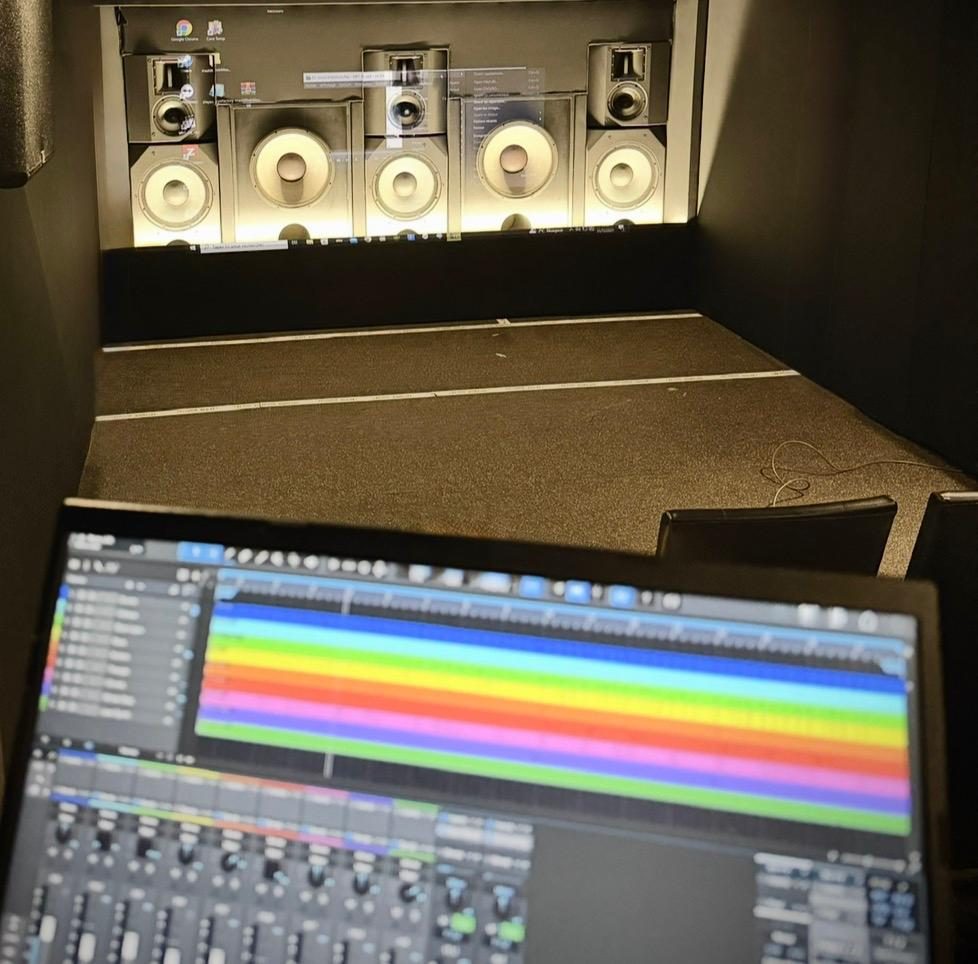
Room modes: identifying and treating the low end
Below a certain frequency a room stops behaving like a space and becomes a resonator. Peaks and dips in the low end are then no longer a speaker fault, but a property of the room.
What a room mode is
Between two parallel surfaces, a wave that completes the round trip in a whole number of wavelengths comes back in phase with itself. It adds to itself, and a standing wave sets in: a pattern fixed in space, with places where pressure is at a maximum and others where it almost cancels.
Modes are described as axial when they involve two opposite surfaces, tangential when they involve four, and oblique when they involve six. Axial modes carry the most energy, and they are the ones heard first.
Calculating them
For a pair of parallel surfaces a distance L apart, axial modes fall at f = n × c / (2L), where n is 1, 2, 3… and c is the speed of sound, about 343 m/s at 20 °C. For a room of 5.00 × 4.00 × 2.70 m:
| Dimension | n = 1 | n = 2 | n = 3 |
|---|---|---|---|
| Length 5.00 m | 34.3 Hz | 68.6 Hz | 102.9 Hz |
| Width 4.00 m | 42.9 Hz | 85.8 Hz | 128.6 Hz |
| Height 2.70 m | 63.5 Hz | 127.0 Hz | 190.6 Hz |
The table reads both ways. It says where to look for trouble, and it shows the danger of close or multiple dimensions: two similar dimensions stack their modes on the same frequency, producing a peak that is hard to treat. That is the reason behind the proportion ratios recommended for listening rooms.
How far up modes dominate
Above a certain frequency, modes become so numerous and so closely spaced that they merge into a diffuse field: the room then behaves statistically. The boundary between the two regimes is estimated by the Schroeder frequency, approximated as f ≈ 2000 × √(RT60 / V), with reverberation time in seconds and volume in cubic metres.
For the room above, 54 m³, with a reverberation time of 0.3 s, the boundary falls around 149 Hz. Below that, modal behaviour becomes particularly important; above it, the statistical analysis of the field and the role of reflections and absorption progressively take on more weight. It is an estimate rather than a sharp border, but it places the problem correctly.
Below the Schroeder frequency the room is a resonator, and position matters as much as the speaker. Above it, the reasoning changes in nature.
What it sounds like
Three symptoms keep coming back. An uneven low end from seat to seat: a note holds in one chair and disappears a metre away. One or two notes that stand out systematically, whatever the track, because they land on a mode. And a low end that lingers: sound continues after the note stops, which blurs the reading of the groove and pushes towards under-dosing the bass in the mix.
What works, and in what order
The levers are not interchangeable, and the order matters.
- Proportions, while the room is still to be built. That is the only moment when mode distribution is chosen rather than endured.
- Positions, of the speakers and of the listening seat. Moving the listener out of the minima costs nothing and is tested in minutes.
- Low-frequency absorption, in volume and thickness, typically in the corners where pressure is at a maximum for most modes. It is the only lever that acts on the duration of the resonance.
- Several low-frequency sources spread around the room, to smooth the response over several seats instead of optimising a single one.
- Equalisation, last. It can reduce a peak. It does not fill a cancellation dip, and it does not shorten a decay.
An equaliser can remove energy where there is too much. It cannot add energy where the room cancels it, nor stop earlier what is ringing.
Measure, then verify
Calculation locates the frequencies to watch, measurement says what actually happens, seat by seat. Prediction tools such as Home Theater Maestro map the modes of a room and compare scenarios before the building work; their results remain decision aids, to be checked afterwards against real measurements.
The logical next step concerns the interaction between speakers and the surfaces around them, covered in our guide on SBIR, and monitor placement.
Got a project in mind?
Send us a few words about your tracks and we will come back with a tailored quote.
Contact us