
Understanding and reducing SBIR in the control room
A speaker standing a metre from a wall produces a cancellation around 86 Hz. That is not a speaker fault, it is a geometric interference, and it can be calculated.
What the acronym describes
SBIR stands for Speaker Boundary Interference Response: the response resulting from interference between a speaker and the surfaces around it. The principle is simple. A speaker radiates in every direction in the lower part of the spectrum. Part of that energy travels towards the surface behind it, reflects off it, and comes back to mix with the direct sound.
That extra path is twice the distance between speaker and surface. When it equals half a wavelength, the reflected sound arrives in opposite phase and subtracts from the direct sound: that is the cancellation. At frequencies where the path equals a whole wavelength, the two add instead.
Where the cancellation falls
The first cancellation sits at f = c / (4d), where d is the distance from the driver to the surface and c the speed of sound, about 343 m/s. The table reads at a glance:
| Distance to the surface | First cancellation |
|---|---|
| 0.30 m | 286 Hz |
| 0.50 m | 172 Hz |
| 0.80 m | 107 Hz |
| 1.00 m | 86 Hz |
| 1.50 m | 57 Hz |
| 2.00 m | 43 Hz |
The highlighted row is the most common situation, and the least favourable: a speaker standing about a metre from the wall hollows out the region where the left hand of the piano, the body of the snare and the upper bass live. That is precisely where most mixing decisions are taken.
The frequency of the first cancellation depends mainly on the geometry and the distance to the wall. Its amplitude and shape also depend on the characteristics and directivity of the speaker. Changing speaker without changing the geometry does not, on its own, move the theoretical frequency of that first cancellation.
Why absorption alone rarely suffices
The intuitive answer is to put an absorber on the wall. It runs into a physical reality: the effectiveness of a porous absorber in the low end depends notably on its thickness, on its acoustic properties and on any air gap left behind it. At 86 Hz, a conventional thin panel is generally not an effective treatment for the low-frequency component of the problem.
A thin panel behind a speaker treats the upper mids and leaves the cancellation untouched. It gives the impression of having acted, without moving the problem.
The three strategies that work
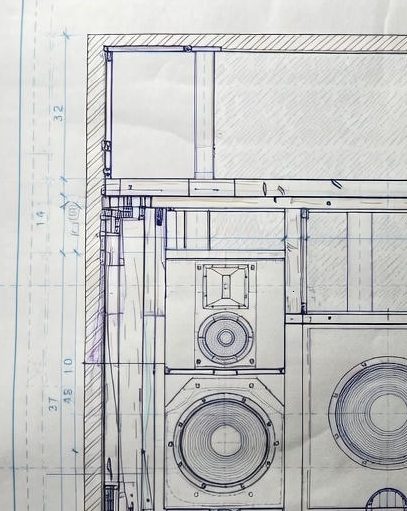
Flush-mount the speaker into the surface, baffle level with the wall. The rear-reflection path responsible for this component of SBIR is strongly reduced, since the front of the speaker sits flush with the wall: the wall becomes an extension of the baffle. It is the most effective solution, and the most demanding, because it is decided at construction and calls for a rigid, decoupled and airtight structure.
Bring the speaker much closer to the surface. At twenty or thirty centimetres, the cancellation rises towards 280 Hz and above, into a region where absorption becomes realistic and thicknesses stay reasonable. One caveat: moving closer also increases low-frequency reinforcement, which has to be compensated in the settings.
Move the speaker clearly away and treat the surface with a thick absorber. This is the most space-hungry strategy, and the least reliable in a control room of ordinary size, because the available distance is rarely enough to push the cancellation below the useful range.
The floor, the ceiling and the worktop
The rear wall is not the only surface involved. The floor produces its own reflection, often the hardest to treat since it is walked on. The ceiling behaves the same way. Finally, a console or worktop between the speakers and the listener creates a short-path reflection whose effect sits higher in the spectrum but remains audible on midrange clarity.
Verify
Calculation says where to look, measurement confirms. A frequency response taken at the listening position shows the anomaly, and moving the speaker twenty centimetres shifts it in a predictable way: that is the best way to be sure it is SBIR and not a room mode. A prediction tool such as Home Theater Maestro makes it possible to simulate those distances before drilling anything, its results still being confirmed by measurement.
On distances and symmetry, see also our guide on monitor placement.
Got a project in mind?
Send us a few words about your tracks and we will come back with a tailored quote.
Contact us