
Choosing and placing your monitor speakers
Placement is the free part of monitoring, and often the part that changes the most. Before changing speakers, it is worth exhausting what the geometry of the room allows.
The listening triangle
The starting point is an equilateral triangle: the distance between the two speakers equals the distance from each speaker to the head. The speaker axes converge on the listening position, and the tweeters sit at ear height with the listener seated in the working position.
This matters more than it looks. Speaker directivity varies sharply with angle in the upper part of the spectrum. A speaker aimed thirty centimetres too high or too low does not deliver the same balance, and no correction puts that right properly.
Equilateral triangle, tweeters at ear height, converging axes. Three conditions that cost nothing and are checked with a tape measure.
Symmetry, before anything else
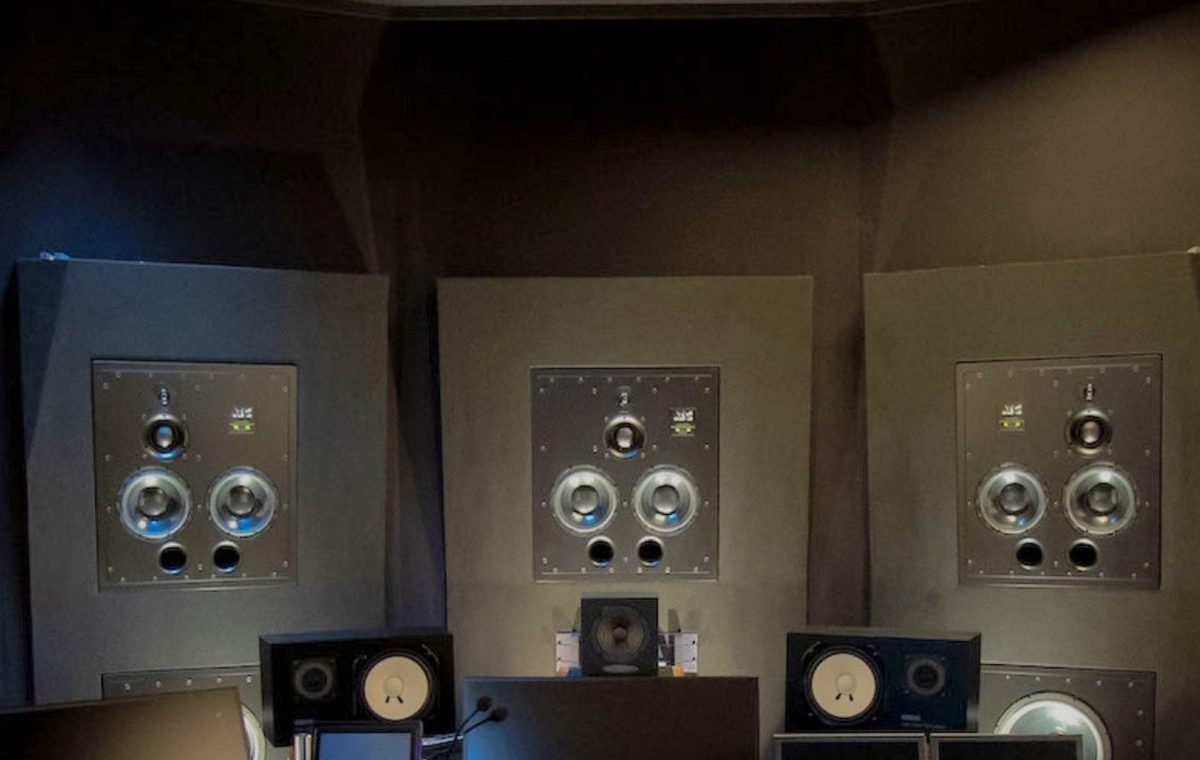
Both speakers must see their surroundings in the same way: same distance to the side wall, same distance to the surface behind them, same nearby surfaces. An asymmetry of a few tens of centimetres is enough to shift the stereo image and make panning decisions unreliable.
In most rooms this means working along the length, with the speakers against the short wall. A setup placed across the width, or angled into a corner, sacrifices symmetry and complicates everything that follows.
The distance to the front wall
Sound radiated towards the back of the speaker returns to the listener after bouncing off the surface behind it. It combines with the direct sound and creates reinforcements and cancellations in the lower part of the spectrum. The phenomenon is regular and calculable, and is covered in detail in our guide on SBIR in the control room.
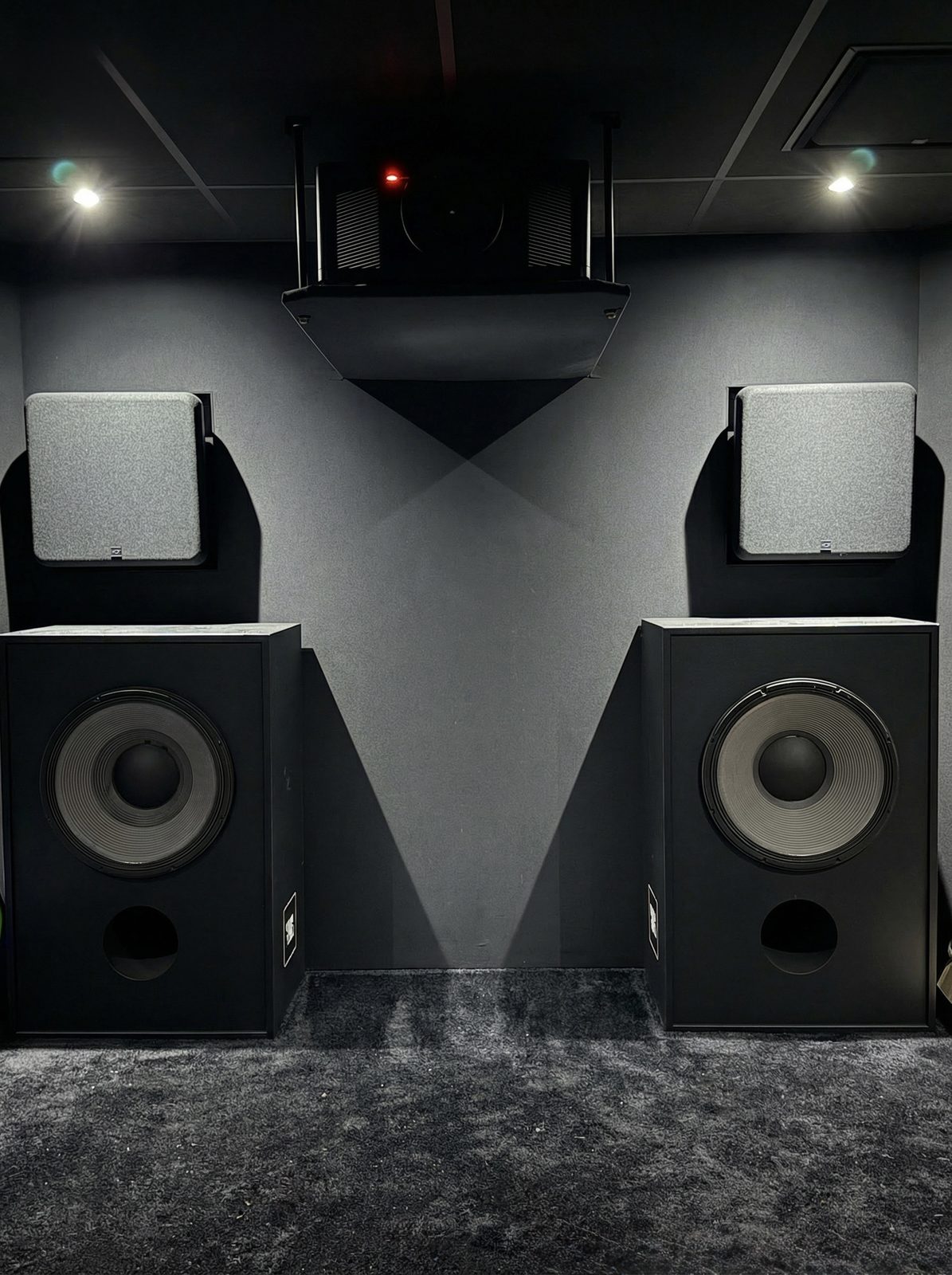
The practical consequence is worth keeping here: two strategies are generally preferred, placing the speaker very close to the wall, or flush-mounting it, or moving it sufficiently far to be able to treat the reflection effectively. A position in between can place the first cancellation in a particularly awkward part of the spectrum.
The listening position along the length
Room resonances create fixed zones of maximum and minimum for every mode. In the simplified model of a rectangular room, the exact middle of the length corresponds to a pressure node of the first lengthwise mode, which can make it an unfavourable position for listening to the low end.
A widespread rule of thumb puts the listener around 38 % of the length from the front wall. It is not a law, it is a reasonable starting point: the right position is found by listening and measuring, moving the seat twenty centimetres at a time. Room modes explain where those zones come from.
Alignment, once the geometry is settled
Then comes what can be adjusted: level matching between channels, time alignment if the speakers are not equidistant, crossover to a subwoofer where there is one. These settings are verified by measurement, not by ear alone, because they involve differences the ear reads as a change of timbre rather than as a alignment fault.
A prediction and analysis tool such as Home Theater Maestro can import measurements and compare them with a model of the room, seat by seat. Here too, measurement has the final word.
What placement does not fix
Placement moves problems, it does not remove all of them. It does not shorten the time a resonance keeps ringing, and it does not compensate for a room whose proportions stack several modes on the same frequency. Past a certain point, what follows is acoustic treatment, and then the design of the room itself.
Got a project in mind?
Send us a few words about your tracks and we will come back with a tailored quote.
Contact us