
Designing a Dolby Atmos mixing room
An immersive room is decided before the speakers are bought. Volume, proportions and symmetry set much of the outcome, and the height layer does not forgive approximation.
Start with the room, not with the speaker list
The common reflex is to pick a format, then look for somewhere to put the speakers. The opposite order gives better results. A room imposes its low-frequency behaviour through its volume and its proportions, and no speaker makes up for what the room degrades.
Two practical consequences. First, a more complex multichannel format does not by itself guarantee a better result: the volume, the proportions, the listening position, the speaker placement and the acoustic treatment must all remain compatible with the room. Second, ceiling height becomes a first-order criterion, since part of the system will live up there.
Channel count is a production choice. The volume and proportions of the room are a physical constraint, and that constraint decides first.
The base layer before the height layer
The horizontal layer remains the foundation of the system: it carries most of the music and the dialogue. It follows the conventions of multichannel stereophony. Recommendation ITU-R BS.775-4 provides the reference for the layout of the horizontal-layer channels.
The admissible angles for the height layer are defined in the Dolby documentation applicable to the target configuration and may vary according to it. Quoting them from memory would be pointless: they are checked against the document in force at the time of design, which evolves. What does not change is the requirement for regularity: the height speakers must see the listening position in the same way on the left and on the right.
Symmetry is a construction constraint
A left speaker 1.20 m from its side wall and a right speaker 1.60 m from its own do not produce the same interference. Dips and peaks do not land on the same frequencies, and the stereo image shifts in a way no level adjustment puts straight again.
This is true in stereo, and it multiplies in immersive work: every speaker added creates its own set of reflections with the surfaces around it. An asymmetric immersive room accumulates faults instead of averaging them. Symmetry is settled during construction, not during cabling.
The low end decides whether the image is credible
In an immersive room, the low end is usually what gives away a weak design first. It is modal: below a certain frequency the room stops behaving like an open space and behaves like a resonator, with fixed maxima and minima. Two seats a metre apart can hear two different balances.
The levers are known, and are used in this order: room proportions while they are still negotiable, position of the sources and of the listening seat, low-frequency treatment, then distribution across several subwoofers to smooth the response over all the seats. The mechanism itself is covered in our guide on room modes.
Passive treatment first, correction afterwards
Electronic correction acts on the signal sent to the speakers. It can attenuate a level peak. It can neither fill a dip caused by cancellation, nor shorten the time a resonance keeps ringing after the signal stops. That decay time is dealt with by absorption, which means material and volume.
Applying correction at the end of the process, to an already treated room, gives a very different result from the same correction used to compensate for a bare room. The same holds for the interference between speakers and the surfaces around them.
Electronic correction comes last, on a room that is already treated. The reverse order means hiding a problem rather than solving it.
Verify rather than assume
A design is validated by measurement, not by calculation alone. Prediction tools exist to compare scenarios before the building work, to rule out clearly unfavourable layouts and to put an order of magnitude on things. That is what Home Theater Maestro does, published by the same company as this site: its predictions are decision aids, and are then confirmed by real measurements.
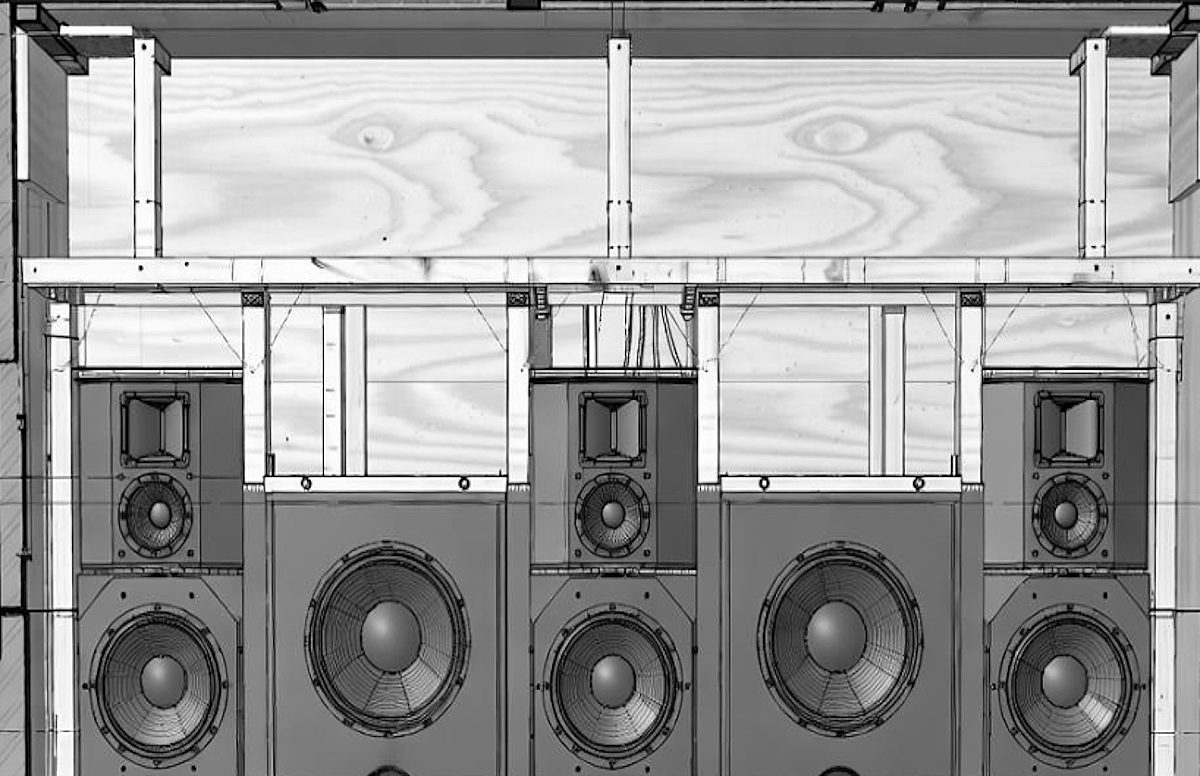
Both our immersive rooms were designed in that spirit: the Black Room in 9.4.4 and the Alcons room in 7.4.4. On delivering the files themselves, see how to deliver a Dolby Atmos Music project.
Got a project in mind?
Send us a few words about your tracks and we will come back with a tailored quote.
Contact us