
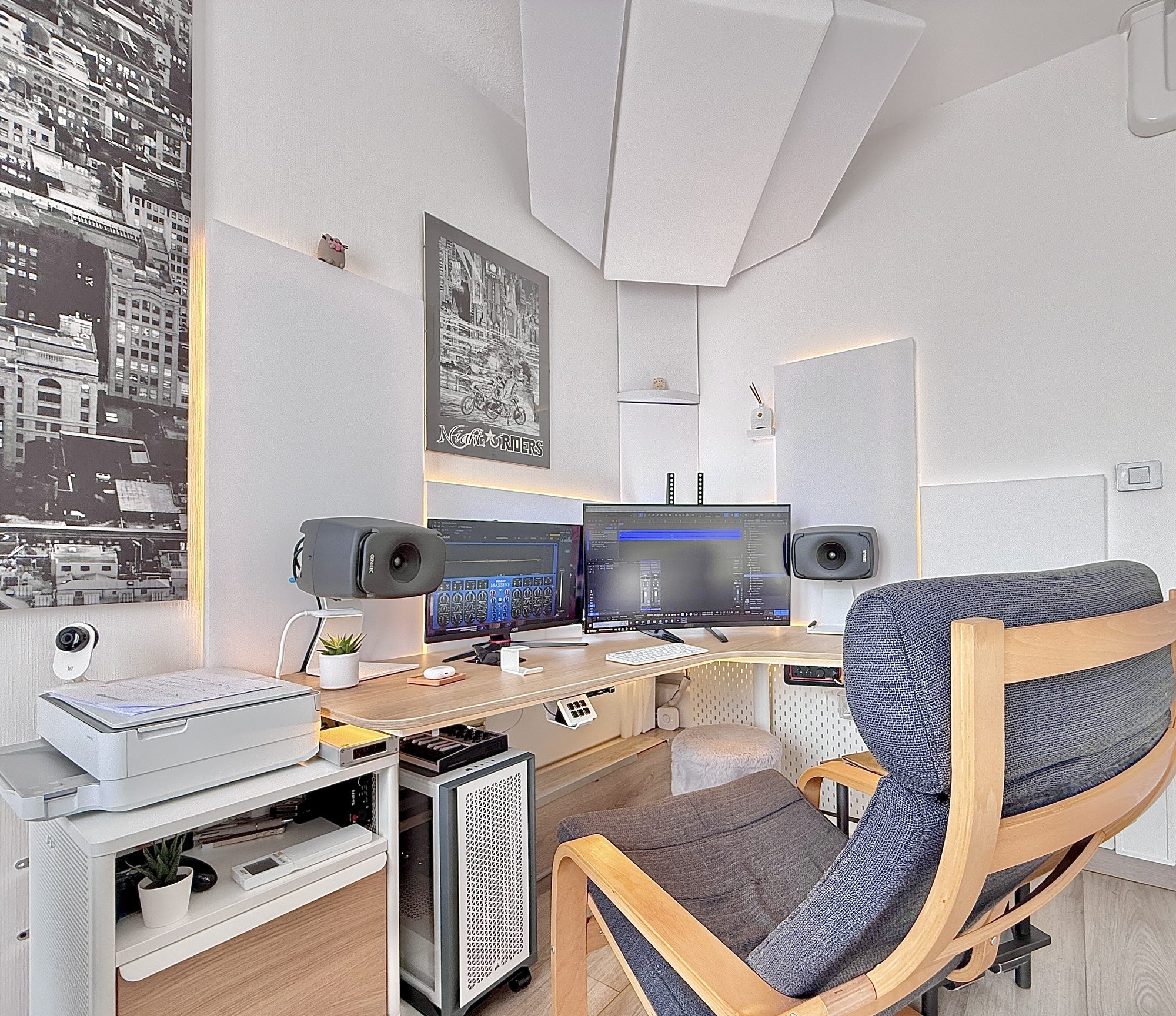
The acoustic principles of a control room
Before talking about treatment, it helps to understand what happens in a control room: the direct sound of the speaker, early reflections, the behaviour of the low end and the role of diffusion.
Hearing the speaker before the room
The goal of a control room is to give the direct sound a dominant influence at the listening position, while controlling early reflections and the room's reverberation. Direct sound reaches the ear first; reflected energy arrives afterwards, delayed in time, and blends into what we hear. The more this early energy is controlled, the more judgement bears on the mix rather than on the place.
This is a question of proportions and placement as much as of treatment: speaker placement and listening distance already set part of the ratio between direct and reflected sound.
A control room aims to make the speaker heard before the room. Everything else follows from that goal.
Early reflections
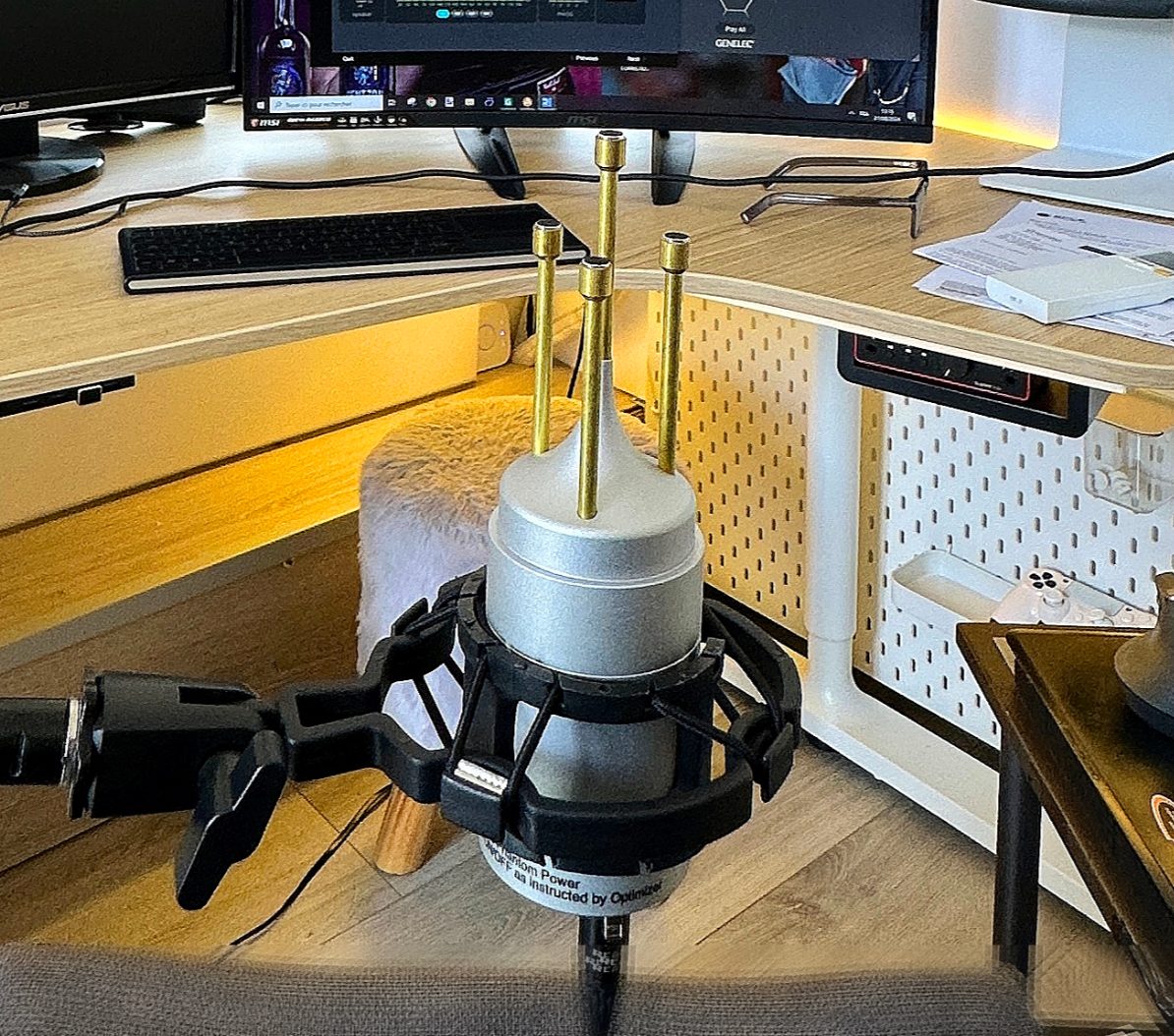
Early reflections are the earliest bounces of sound off nearby surfaces: desktop, side walls, ceiling, console faces. When they return shortly after the direct sound, they can colour the timbre and blur the precision of the stereo image, because the ear receives almost the same signal twice, very close together.
A common approach is to reduce these early reflections around the listening position, through absorption or the orientation of surfaces, so as to clear a zone where direct sound dominates. The aim is to attenuate their effect, not to claim to remove them entirely.
The low end behaves differently
In the bottom of the spectrum, the room no longer behaves as a simple collection of reflections: its dimensions favour modal resonances that create significant spatial variations in low-frequency level, with zones of reinforcement and cancellation. This is the domain of room modes, to which are added the interferences between the direct sound and reflections off the surfaces near the speaker, notably the phenomenon commonly called SBIR. These phenomena are treated differently from the rest of the spectrum, generally with thicker devices.
Diffusion, not only absorption
Reducing reflections does not mean absorbing everything. Diffusion redistributes reflected energy in several directions and, depending on its geometry, in time, rather than absorbing it, which can keep the room a lively character while avoiding distinct echoes. It is often used on surfaces further from the listening position, at the back of the room for instance.
The balance between absorption and diffusion is a design choice, developed in our guide on absorption, diffusion and the precision/comfort balance.
Finding the balance
An over-absorbed control room can become excessively dead and lose part of the naturalness of listening, and represent imperfectly how most listeners will hear the music. An over-lively room blurs the analysis. The right balance depends on the use — mastering, mixing, creation — and there is no universal setting valid for every room.
Verifying by measurement
The principles above are observed and adjusted by measurement: reverberation time per band, early-reflection energy, low-frequency response at the listening position. A prediction and analysis tool such as Home Theater Maestro lets you compare measurements against a model of the room and estimate some of these behaviours in advance. Predictions remain decision aids, to be confirmed by real measurement.
Direct sound, early reflections, low end, diffusion: four families of phenomena that are not treated the same way, and that are verified by measurement.
A project in mind ?
Send us a few words about your tracks, and we will reply with a tailored quote.
Contact us