

Choosing monitor speakers for mixing and mastering
Monitoring is the sound engineer's measuring instrument. The goal is not the most flattering speaker, but the one that makes judgement most reliable, in a given room and at a given distance.
What a monitor speaker is for
A monitor speaker does not have the same job as a consumer speaker. We do not ask it to flatter, but to reveal: to show what is right and what is wrong in a mix, as honestly as possible. A pleasant speaker that embellishes everything leads to decisions made on a false picture, which you then discover on other systems.
The first criterion is therefore neutrality: a frequency response without marked accidents on the listening axis, low distortion at working levels, and stable behaviour as the level rises. These are measurable quantities, published by serious manufacturers, and open to verification.
You do not choose the speaker that flatters most, but the one that lets you make the most reliable decisions.
Off-axis response matters as much as on-axis
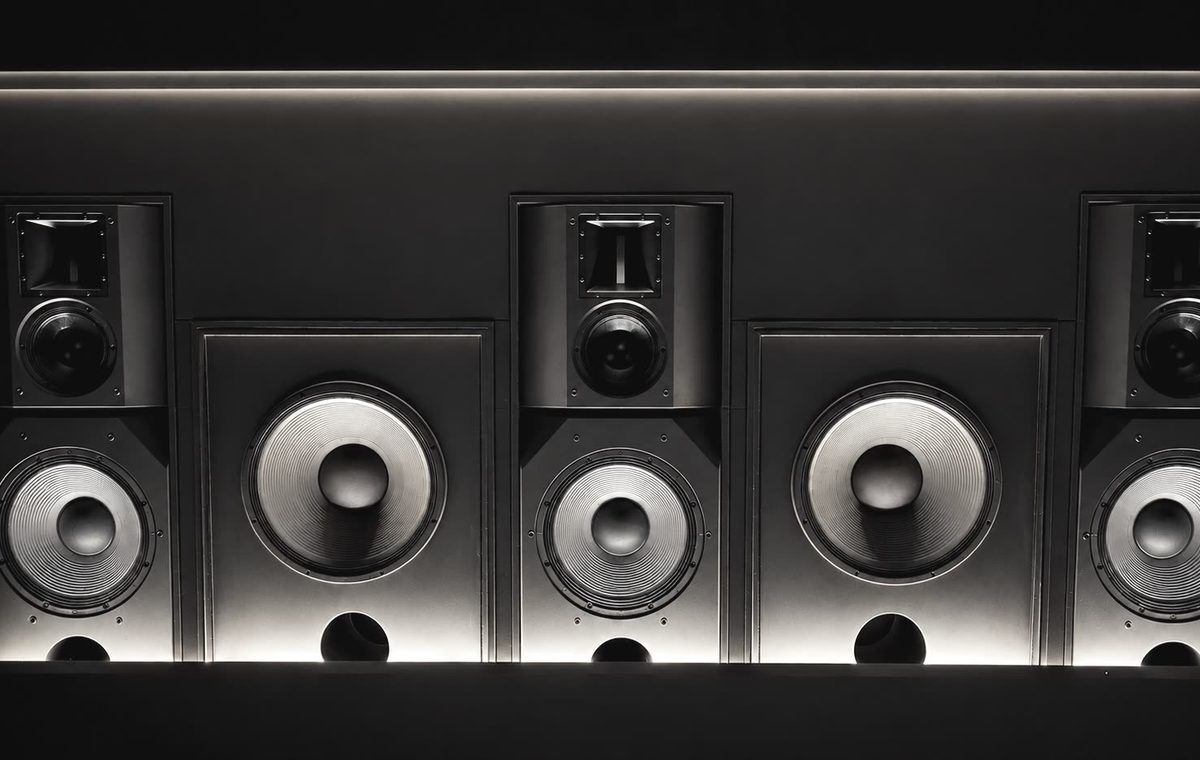
In a room, the ear receives the direct sound of the speaker, but also its energy reflected off the walls. That energy arrives from every angle, not only from the axis. A speaker whose response degrades sharply off-axis sends a different colour into the room than it produces straight ahead, and that colour returns to the ear through the reflections.
This is why the regularity of directivity — how the radiation evolves with angle — is a criterion as important as the on-axis curve. It explains why a speaker measured "flat" can seem unbalanced in a real room. The subject connects directly to room acoustics: room modes and SBIR describe part of what the room adds to the signal.
Active or passive
In an active speaker, amplification and filtering are built in and tuned by the manufacturer for its own drivers. Each way has its amplifier, filtering happens before amplification, and many models add a room-adaptation setting. It is the most common configuration in studios, mainly because it reduces the number of variables to master.
A passive speaker leaves the choice of amplification open and requires a coherent match between amplifier and speaker. Filtering and amplification remain separate, which adds variables to master. This is not a fault in itself, but it demands more command of the monitoring chain.
Two-way, three-way, and the question of the low end
The number of ways describes how the speaker splits the spectrum between its drivers. A two-way (woofer-midrange and tweeter) is simple and coherent; a three-way generally adds a dedicated midrange, which can relieve the woofer-midrange driver in the midrange region. The number of ways is not a quality score: a good two-way remains preferable to a poorly tuned three-way.
Low-frequency extension depends mainly on driver size and cabinet volume, and it quickly runs into the room. Adding a subwoofer can extend the bottom end and allow bass management different from that of the main speakers. Several bass sources, correctly positioned and integrated, can also help smooth the spatial response. A subwoofer is not set by ear alone: level, phase and crossover frequency are verified by measurement.
Matching the speaker to the room and the distance
A speaker is chosen for a given listening distance and room volume. A large speaker placed a metre away in a small control room does not "sound bigger": it can strongly excite the room's modes and become hard to integrate. Conversely, a small nearfield listened to from far away in a large room will lack level and extension.
In practice we distinguish nearfield, midfield and main speakers, the latter notably used in large control rooms. The suitable working distance depends on the speaker's design, the listening level and the room. The right choice follows from the room and the distance, not from the most impressive datasheet. The placement that follows is covered in choosing and placing your monitors.
Listen in your room, then measure
A speaker is not judged in a dealer's demo room: it is judged in the room where it will work, on known references. What you think you hear from a speaker is, in large part, what the room does to it.
Built-in correction systems and alignment software help compensate for some room defects, but they replace neither good placement nor acoustic treatment: electronic correction does not shorten how long a resonance keeps ringing. A prediction and analysis tool such as Home Theater Maestro lets you compare measurements against a model of the room, seat by seat, to help tell what comes from the speaker from what comes from the place.
The speaker, the distance and the room form a whole. Choosing the speaker without considering the other two is deciding blind.
And if the listening becomes multichannel
Moving to multichannel or immersive shifts the priorities: you then need several speakers that are coherent with one another, a real centre channel and suitable bass management. Those differences are detailed in stereo or multichannel monitoring, and the room that must host them in designing a Dolby Atmos mixing room.
A project in mind ?
Send us a few words about your tracks, and we will reply with a tailored quote.
Contact us