
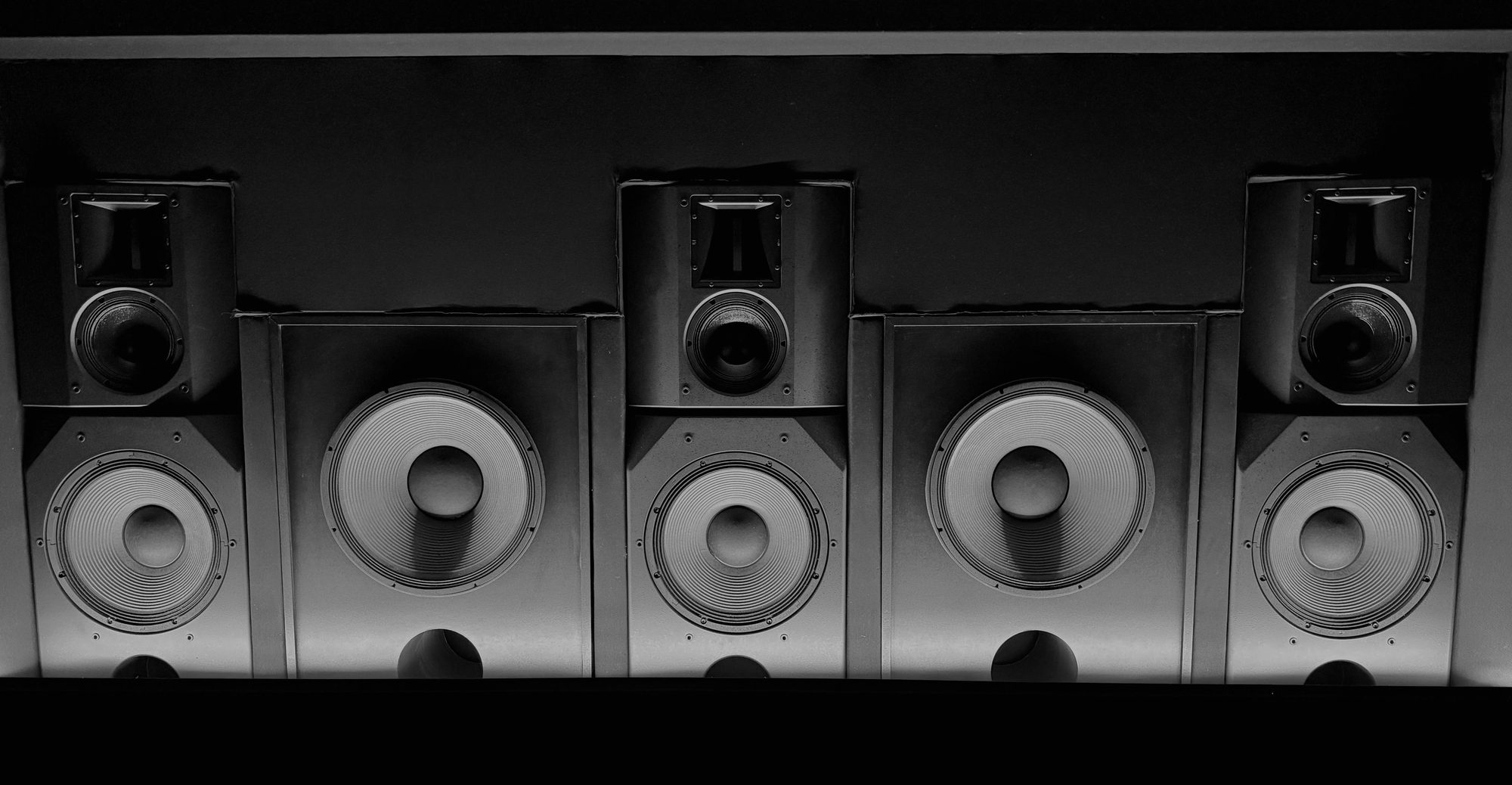
Stereo or multichannel monitoring: what changes for the sound engineer
Moving from two speakers to a multichannel system does not just add channels: it changes how the sound image is built, how the room takes part, and how the low end is managed.
Two different demands
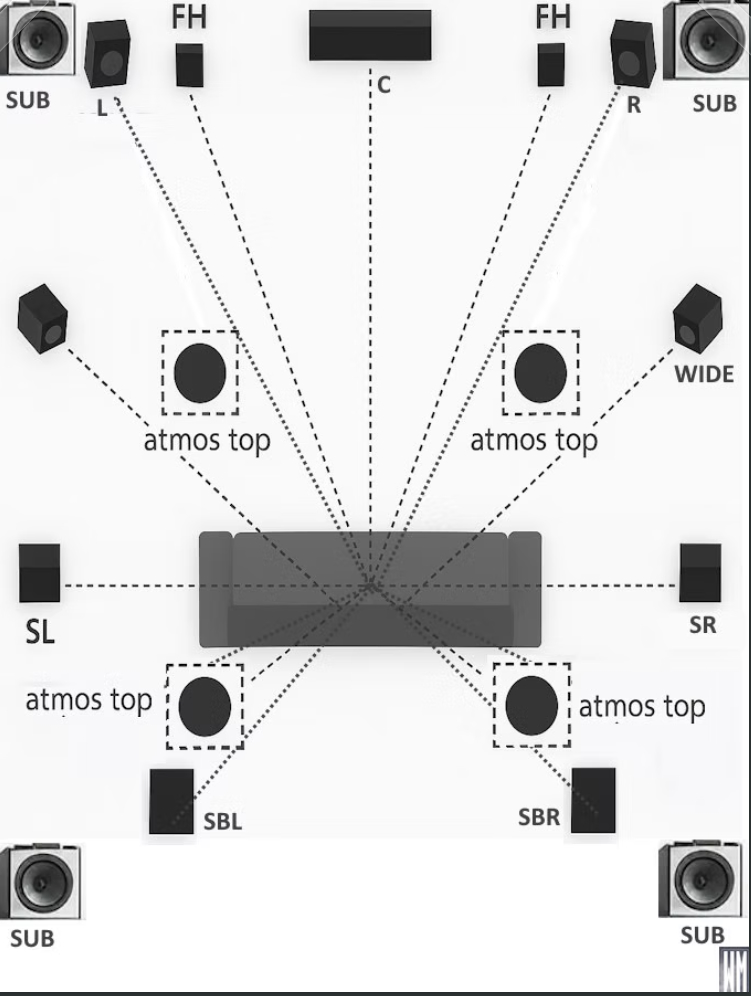
In stereo, everything happens between two speakers: the sound image spreads along the line joining them, and most of the work is about obtaining a stable, precise scene from those two sources. In multichannel, several directions are reproduced by dedicated speakers: centre, sides, surrounds and, in immersive, height speakers. You are no longer looking only for an image between two points, but for coherence between several sources spread around and above the listener.
Stereo asks for a perfect image between two speakers. Multichannel asks for coherence between several, which multiplies the constraints rather than adding to them.
The phantom centre versus a real centre channel
In stereo, a sound placed in the middle does not exist physically: it is a phantom centre, created by both speakers emitting at once. It depends heavily on symmetry and on the listening position: as soon as the listener moves off-centre, the level and arrival-time differences between the two speakers can shift or degrade the central image.
In multichannel, the voice and central elements pass through a real centre channel. The anchoring can be more stable for a slightly off-centre listener, provided the placement and directivity of the centre channel are properly controlled. This difference has concrete consequences: a multichannel mix is not judged like a folded-down stereo mix, and how the centre is used is part of the artistic decisions.
Symmetry, a constraint multiplied
Stereo already imposes strict left-right symmetry. Multichannel extends it to every channel: each speaker must be aligned in level and time relative to the listening position, and the symmetrical pairs (sides, surrounds, heights) must see the room the same way. The more speakers there are, the more interactions with the walls, and the more settings there are to verify.
What was a single pair to tune becomes a set to hold together. This is also why placement and room symmetry matter even more in immersive.
Bass management and the LFE channel
In multichannel, the low end needs its own organisation. Bass management redirects the low frequencies of the channels to the speakers or subwoofer able to reproduce them, which requires consistent crossover frequencies and levels across channels.
This should not be confused with the LFE channel, the ".1" of 5.1 or 7.1.4 formats: it is a separate low-frequency effects channel, not simply a stereo subwoofer. Its relative level is defined by the format, and an LFE that is poorly aligned or poorly calibrated can noticeably change the reproduction of the low end. These alignments are verified by measurement, a subject developed for immersive in our room design and analysis guide.
The room must hold more positions
A stereo monitoring setup is generally optimised around a reference listening position. Immersive listening calls on the room in more directions, including overhead, and often for several seats. The room must therefore behave well across a greater number of angles and places, which makes acoustic treatment and proportions even more decisive. Room modes and SBIR do not vanish in multichannel: they arise for more sources.
Moving from stereo to multichannel
A control room set up for stereo is not automatically a good multichannel room. Adding speakers around and above the listener means revisiting placement, symmetry and calibration, and sometimes the room itself. That is the subject of designing a Dolby Atmos mixing room, and of speaker choice in choosing monitor speakers.
A prediction and analysis tool such as Home Theater Maestro lets you place up to several dozen channels in a model of the room and compare measurements against predictions, seat by seat. Measurement remains the arbiter, in stereo as in immersive.
Multichannel is not stereo "made bigger". It is a set of channels to make coexist in a room that must stay accurate for each of them.
A project in mind ?
Send us a few words about your tracks, and we will reply with a tailored quote.
Contact us